Patient management
On the Patient Management, you can view and manage patients in certain institution. Click Patient Name to navigate to the detail page.
Note
If a user is an ordinary member, only the patients of user under certain institution can be managed.
Patient list
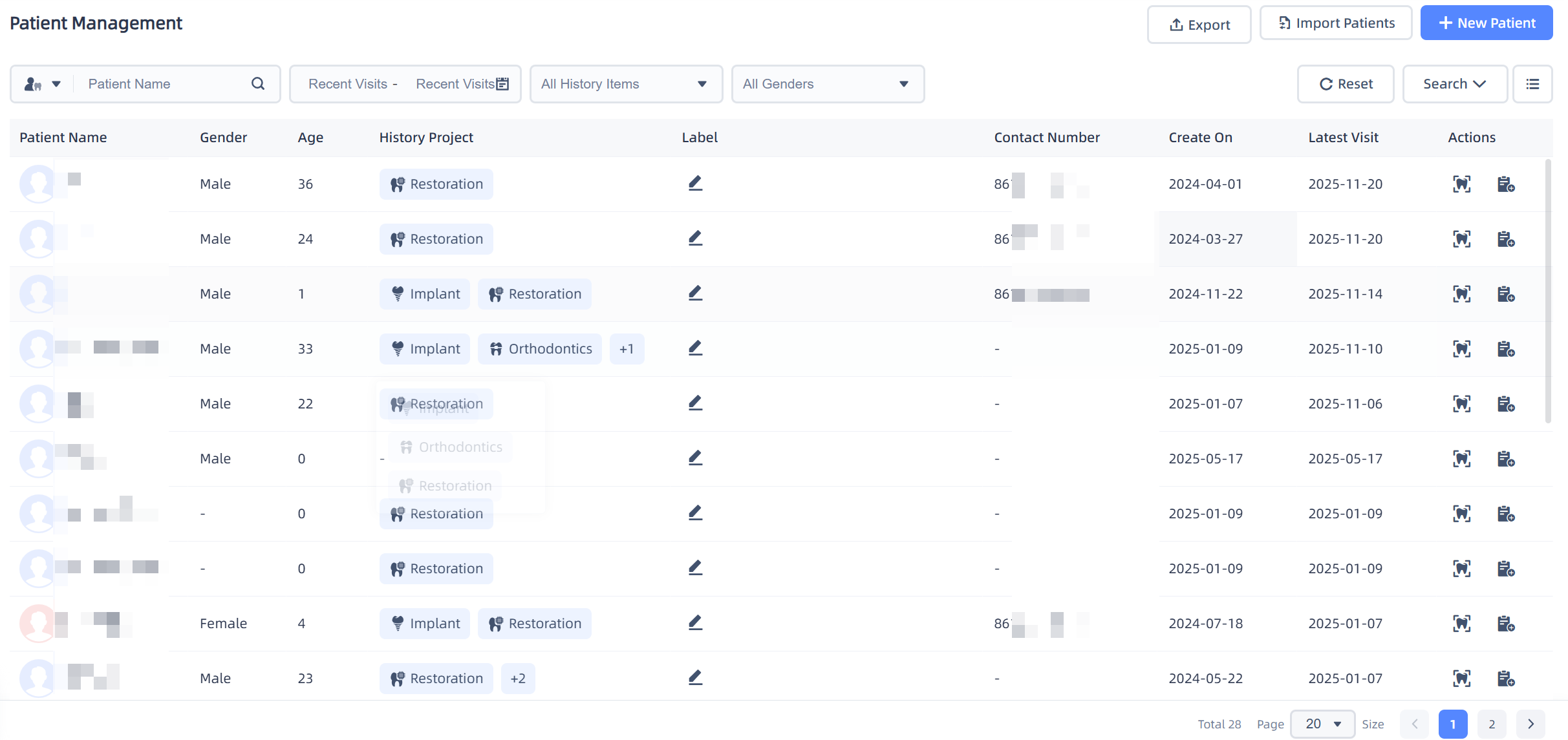
| Function | |
|---|---|
| Export | Export patient information from the current interface to local in table (xlsx) format. Note NoteMaximum 1000 patient records can be exported at a time. |
| Import Patients | Import patient information to this platform.Note To ensure successful data import, please download the template first, fill in patient information according to the template, and then perform the import. |
| New Patient | Click New patient and a drawer named New patient appear from the page's right margin. Fill in the name, gender, date of birth and other information, then click Submit.Note When adding a new patient, you can create a scan ticket as well. After checking the option on the page, you can directly create a scan ticket. |
 Reset Reset |
Click the button to reset filter |
| Search | To expand the filters. |
 |
Click to select the information display items for the current patient list. |
 |
Click the button and a drawer named New Creation appear from the page's right margin. You can choose Intraoral or Face Scan, and fill in case type, visit type, doctor, and other information. Then click Create. |
 |
Click this button to navigate to the Create Case interface. |
Detail page
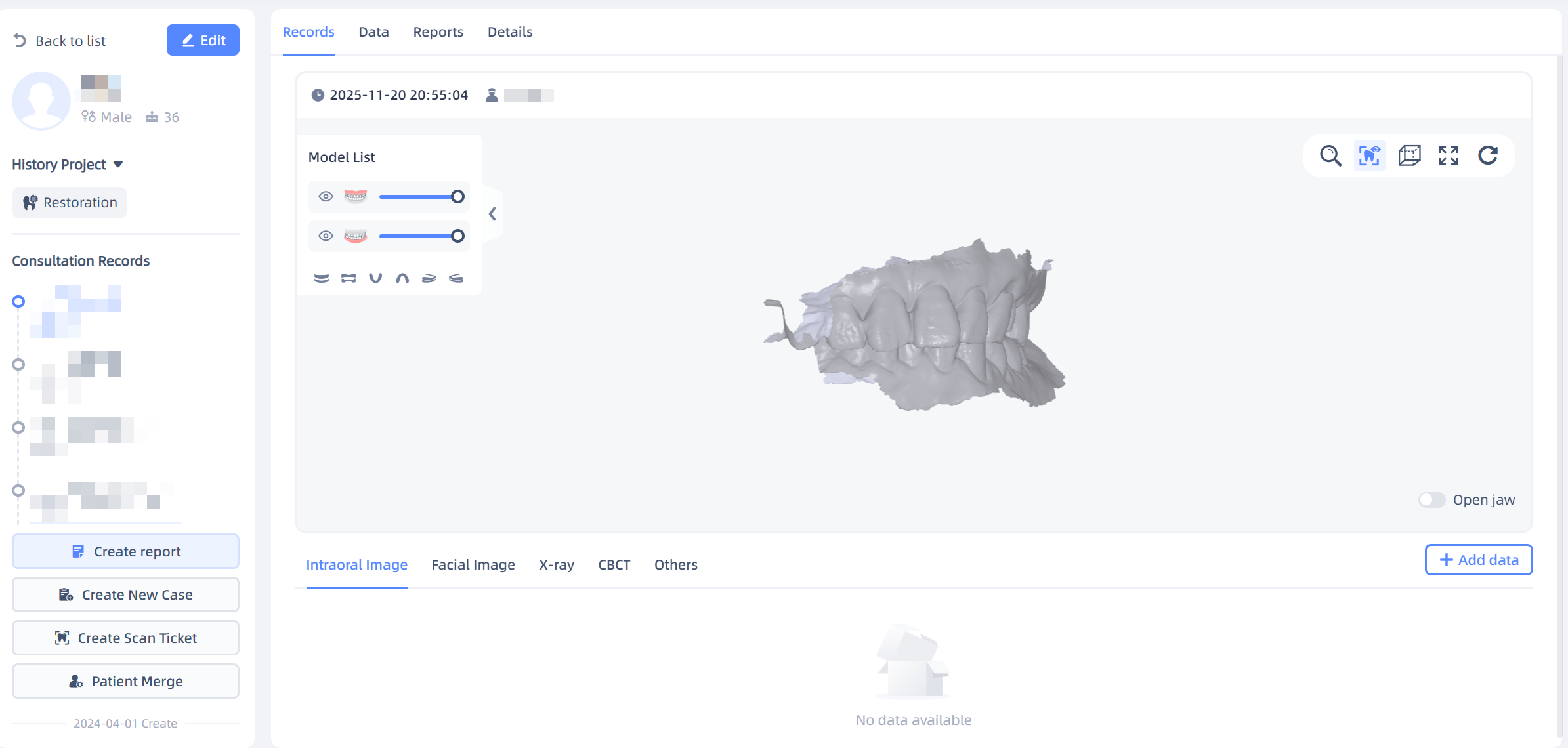
 Edit: Edit patient's basic information. Click this button and a drawer named Edit patient appear from the page's right margin, where you can change the patient's basic information.
 -
 Creating reports:Click this button and select multiple data (Intraloral scan model is necessary and CBCT can not be selected) as needed; click Confirm to open the Settings Of Health Checking Report window, and click Start to enter the report editing page.
Note
- To generate a health checking report, the intraoral scan data is required.
- If multiple sets of intraoral scan models are selected, the upper and lower jaw models will be selected by default. If multiple sets of face scan models are selected, the smiling face will be selected by default.
- If prompted with the message “The temporary preview file has been expired”, please click Regenerate before creating a report.
- If prompted with the message “The uploading device of this data does not have permission to create reports”, please check if the upload device for the intraoral scan model belongs to a third party or if it has received authorization.
-
Create New Case: Click this button to navigate to the Create Case interface.
-
Create Scan Ticket: Click this button and a drawer named New Creation appear from the page's right margin. You can choose intraoral or face scan, and fill in case type, visit type, doctor and other information. Then click Create.
-
 Patient Merge: Click this button and a drawer will appear. You can screen or find similar patients by entering patients' name or contact information.
 Note
- The profile of patients that were merged will be kept, and their records, scan tickets and cases will be merged into the main patient records.
- You can also select more than one patient which can be found in the selected list on the right column. Click trash
 to delete the selected similar patient. If you want to delete all of them, click Clear all. This operation doesn't have two-step confirmation, please operate carefully.
- Display the patient's most recent visit records at this institution; you can select the visit records to display and edit visit record names on the left side of the page.
- You can add data on this page, and the uploaded image data will be displayed in the corresponding visit records. In each visit record, you can view different image data by switching tab icons.
Note
- Click on single intraoral image, facial image, or X-ray image thumbnail to enlarge, and you can download the image after enlargement.
- Clicking on CBCT or folder
 of other image data will automatically download them.
Display all image data of this patient.
-
The thumbnail images of intraoral scan and facial scan types are individual model files. Clicking will open the Model Preview window. For detailed introduction, please refer to Preview.
-
The thumbnail images of intraoral photos, facial photos, and X-rays are image collections. Click to enlarge, and you can download after enlargement.
-
Click the select data icon
 to select multiple types of image data. After selection, click the create new case icon at the bottom left of the interface, which will jump to the Create Case page. The selected image data will be automatically uploaded as Attachment files for this case.
Note
Each type of image data only supports selecting all images from a single visit record.
-
Click the add data icon in the upper right corner, and the Add Data window will pop up. You can specify to add data to existing visit records or create new visit records, and upload files by clicking the + icon or dragging and dropping directly.
-
Display all visit reports for this patient. You can edit, view report details, view report QR codes, and download reports.
-
If this patient has several reports, which need to be shared in batches, you can click "Share Multiple Reports" in the upper right corner. After selecting all the reports you want to share, click "Generate Report Collection". Then, a QR code for the report collection will be generated.
- After editing the report, you can Generate New Report or Update Report.
- Generate New Report: A new report with a new sharing link and QR code will be generated. The original report will remain unchanged and you can still preview it on the report list.
- Update Report: The content of this report will be updated. The sharing link and QR code will remain unchanged.
Display the basic information and clinical information (past medical history, oral habits and allergic history.)
Model Analysis
Mark
 Modify area
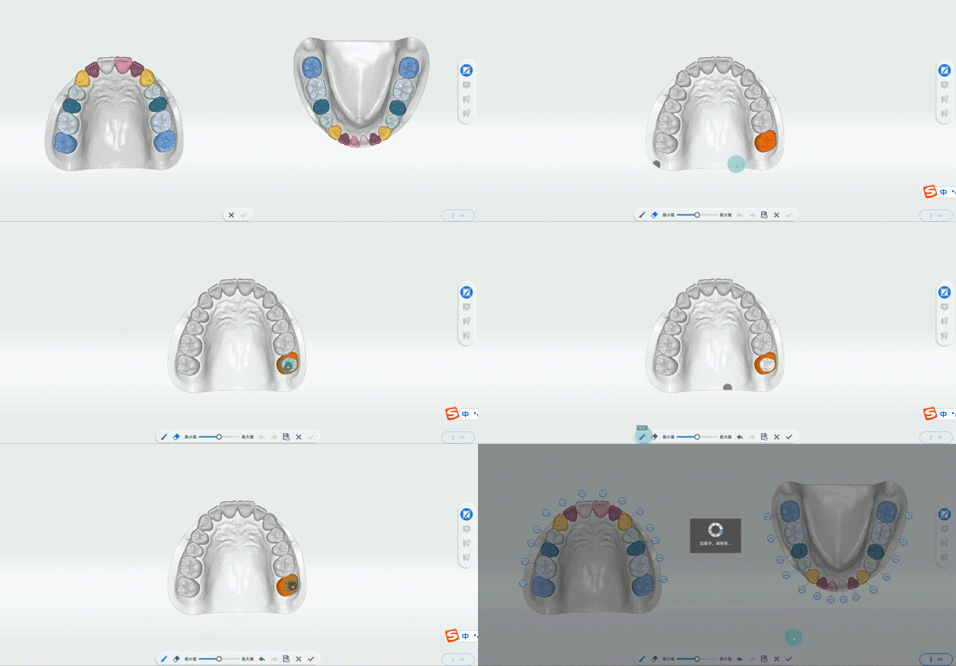
Click to enter the interface of tooth selection. Select a certain tooth to modify its area.
| Name | Description | Name | Description |
|---|---|---|---|
 Brush |
Click Brush to select the tooth area. Drag the slider to adjust the thickness of the brush. |  Erase |
Click Erase to delete the selected area. Drag the slider to adjust the thickness of the eraser. |
 Undo |
Undo the last operation. |  Redo |
Redo the last operation. |
 Draft |
Click Draft to save the current operation and return to the tooth selection interface to select other teeth. |  Cancel |
Cancel all operations and exit Modify Area. |
 Confirm |
Save all operations and return to the segment interface. |
Caution
When tooth regions are wholely erased, a tip of "It is not allowed to remove all tooth regions!" pops up.
 Change tooth number
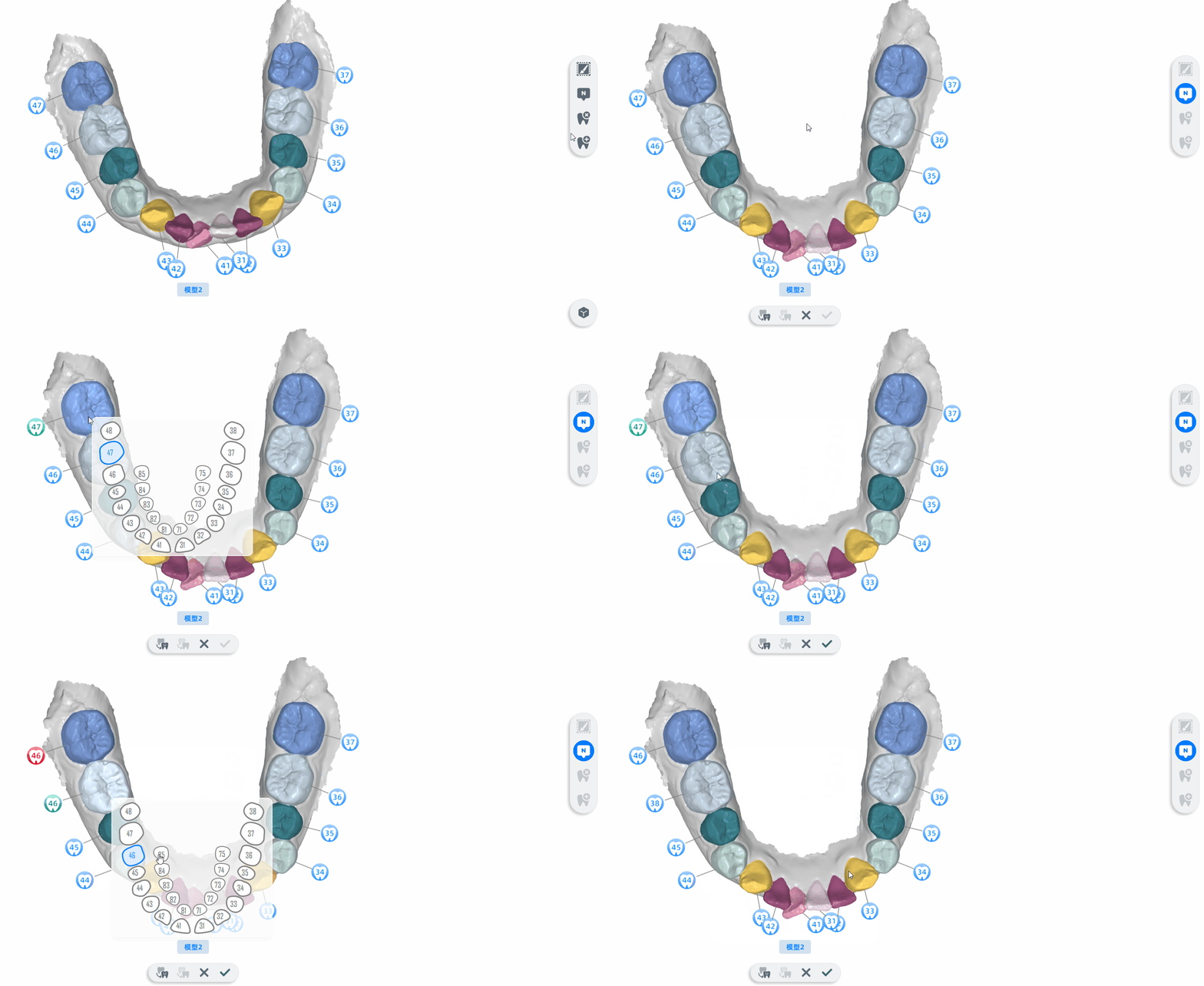
-
Click
to enter the interface of changing tooth number. -
Click the tooth to be re-numbered.
-
Select the tooth number according to the actual situation of the patient.
Note
-
The outer tooth number is permanent tooth (permanent dentition for adults), and the inner tooth number is deciduous tooth (period of mixed dentition for children).
-
When the mixed dentition is selected, only the Moyers Prediction function is supported; when the permanent dentition is selected, the Crowding Measurement, Bolton Ratio Measurement and model comparison function are supported.
-
-
Click
to confirm and exit the operation interface, or click to exit.
Caution
Do not repeat the same tooth number; the red number means tooth position is repeated.
 Remove teeth
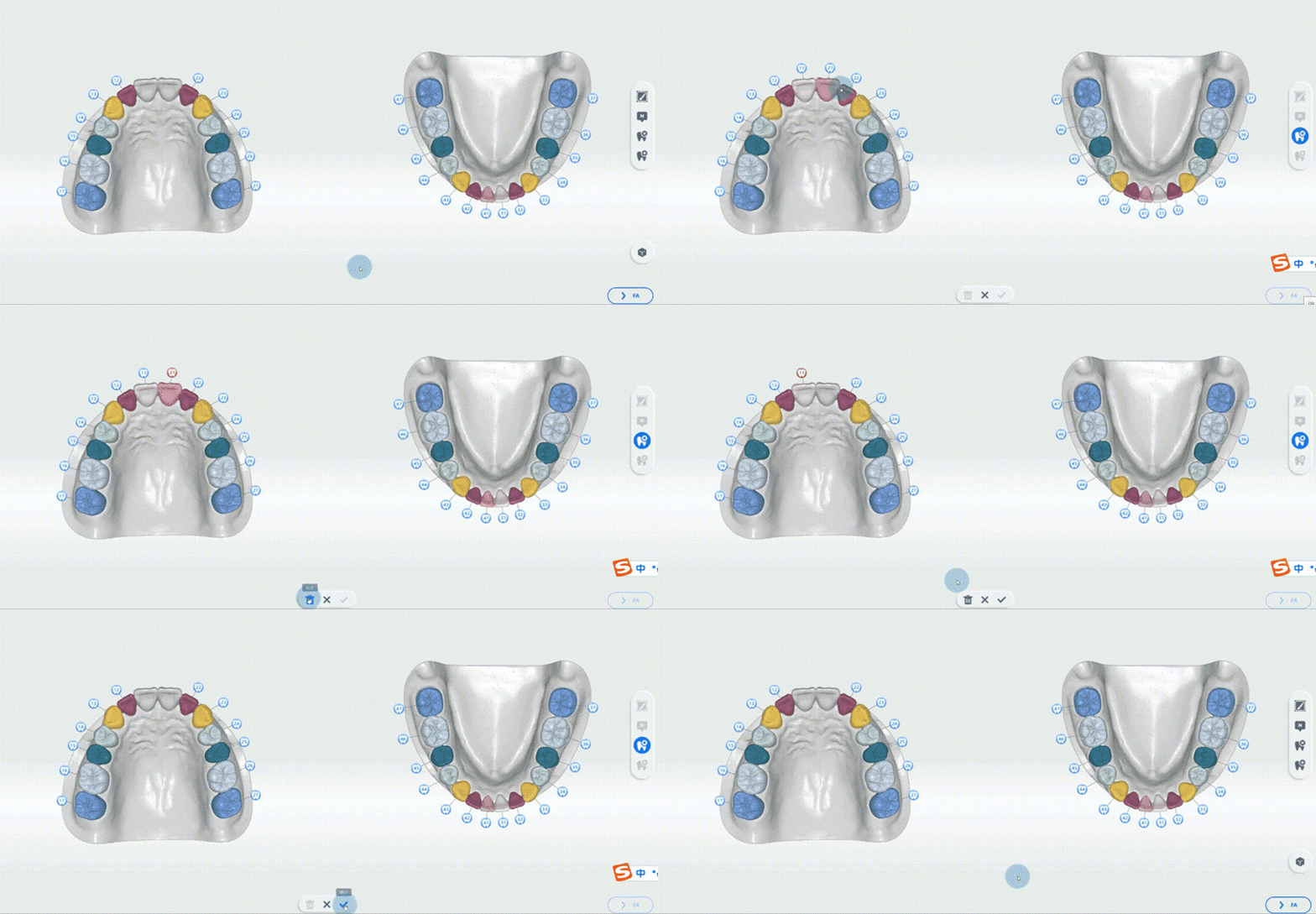
Steps
- Click to enter the interface of removing teeth.
- Select the tooth which should be deleted and the tooth number is displayed in red.
- Click
 to delete it.
 - If more than one tooth needs to be deleted, repeat steps 2-3.
- Click to confirm and exit the operation interface.
 Add teeth
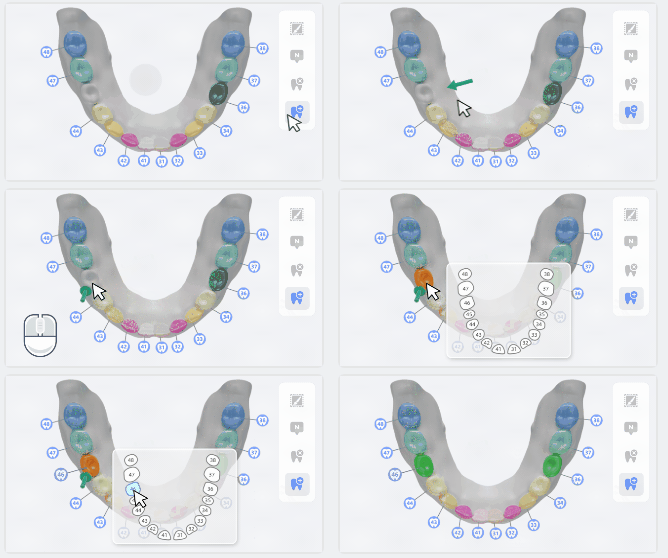
Steps
- Click to enter the interface of adding teeth.
- Double-click the position where the tooth should be added.
- Select the tooth number in the pop-up window.
- Click to confirm.
Caution
Repeat steps 1-4 to add more teeth. And the tooth number should be different.
Crowding
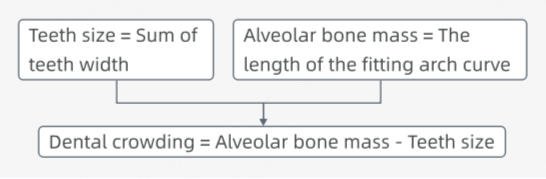
Dental misalignment will lead to dental crowding.  Dental crowding measurement is mainly used to measure the dental crowding of patients at the permanent dentition stage. Dental crowding is an important indicator for determining whether a patient needs tooth extraction. This function will measure the crown width of the permanent teeth and the length of the fitted dental arch. The difference between the two is the crowding.
After entering this function, the fitted dental arch curves of the upper and lower jaws will be automatically generated. A measurement table will be generated as well, including teeth size, alveolar bone mass, and dental crowding results.
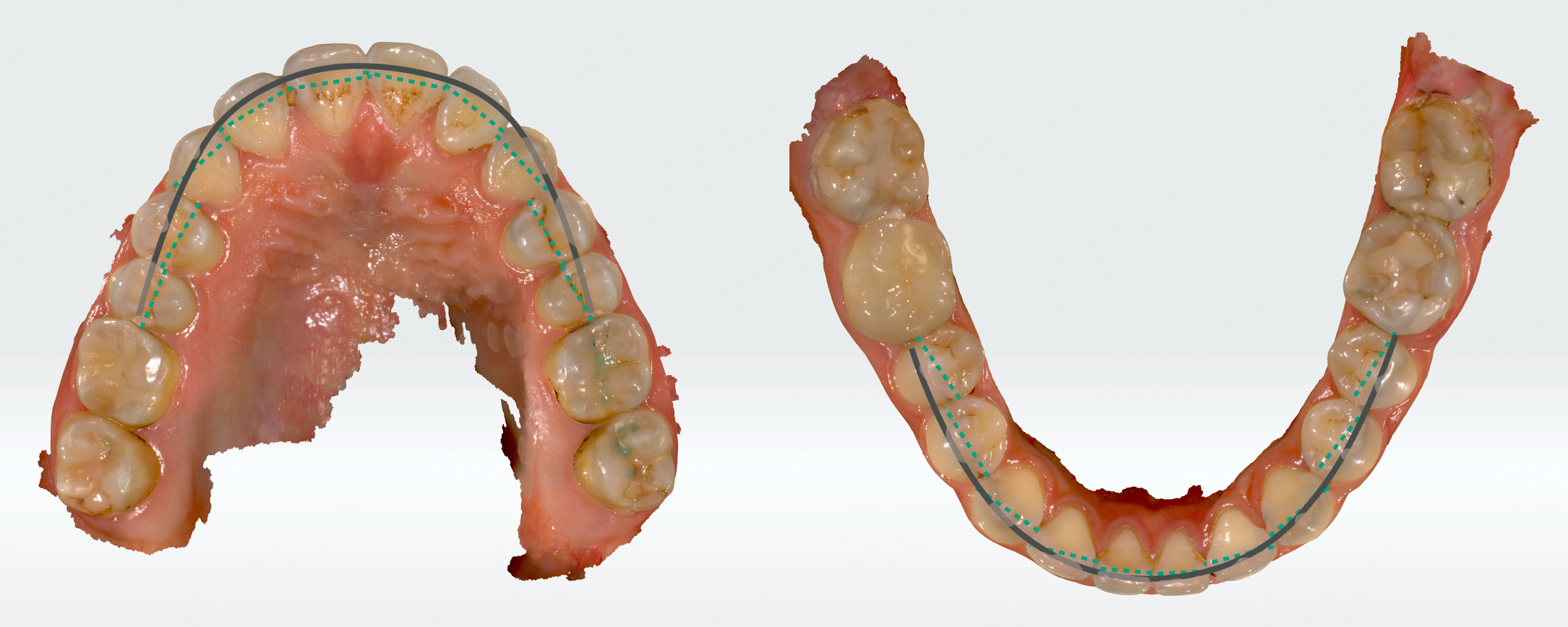
The measurement table provides crowding measurements for 3-3, 5-5, 6-6, and 7-7 dental arches. You can switch the dental arches to obtain different measurement results. Move the cursor to  to view the crowding measurement method.
You can move, zoom, and perform other operations on the measurement table. For details, please refer to Measurement Table Operations.
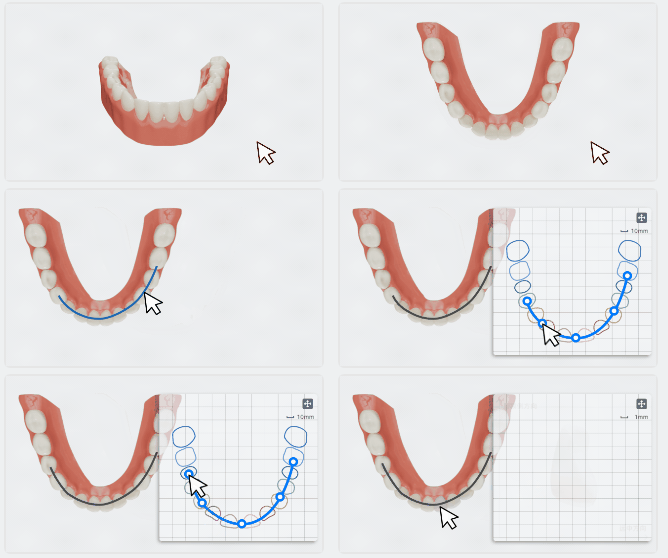
Measurement Method:
-
Click the dental arch (which will be colored in blue), and a panel for dental arch shape adjustment will appear at the bottom right corner.
-
On the panel, you can hold the control point on the dental arch curve and move the cursor to adjust the shape of the dental arch.
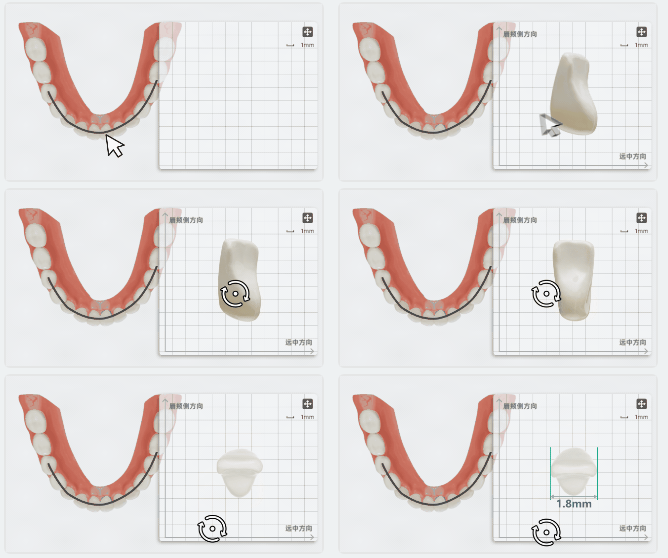
-
After clicking a tooth on the green dashed line, the label will display the tooth width and a panel for width adjustment will appear at the bottom right corner.
-
On the panel, you can rotate the tooth to align the mesiodistal and buccolingual directions with the coordinate axes. The measurement value of the tooth width will be updated in real-time.
Note
To move the panel, you can hold  at the top right corner of the panel and move the cursor.
Moyers
For patients in the mixed dentition stage, you can use the  Moyers analysis. By referring to the Moyers analysis table of tooth width for males and females and the crown width of the erupted mandibular incisors, you can predict the crown width of the upper and lower canines and premolars, thus predicting the dental crowding of the permanent teeth that will erupt.
Caution
- Moyers analysis is only applicable to patients in the mixed dentition stage.
- Moyers analysis is only applicable to the prediction of dental crowding when all the permanent incisors have erupted. The presence of primary incisors will affect the accuracy of prediction.
- When importing a single upper jaw, Moyers analysis is not supported; when importing data for a single lower jaw, Moyers analysis is supported.
After entering Moyers analysis, the fitted dental arch curves of the upper and lower jaws will be automatically generated. A measurement table will be generated as well, including multiple measurement results such as teeth size, alveolar bone mass, and dental crowding prediction.
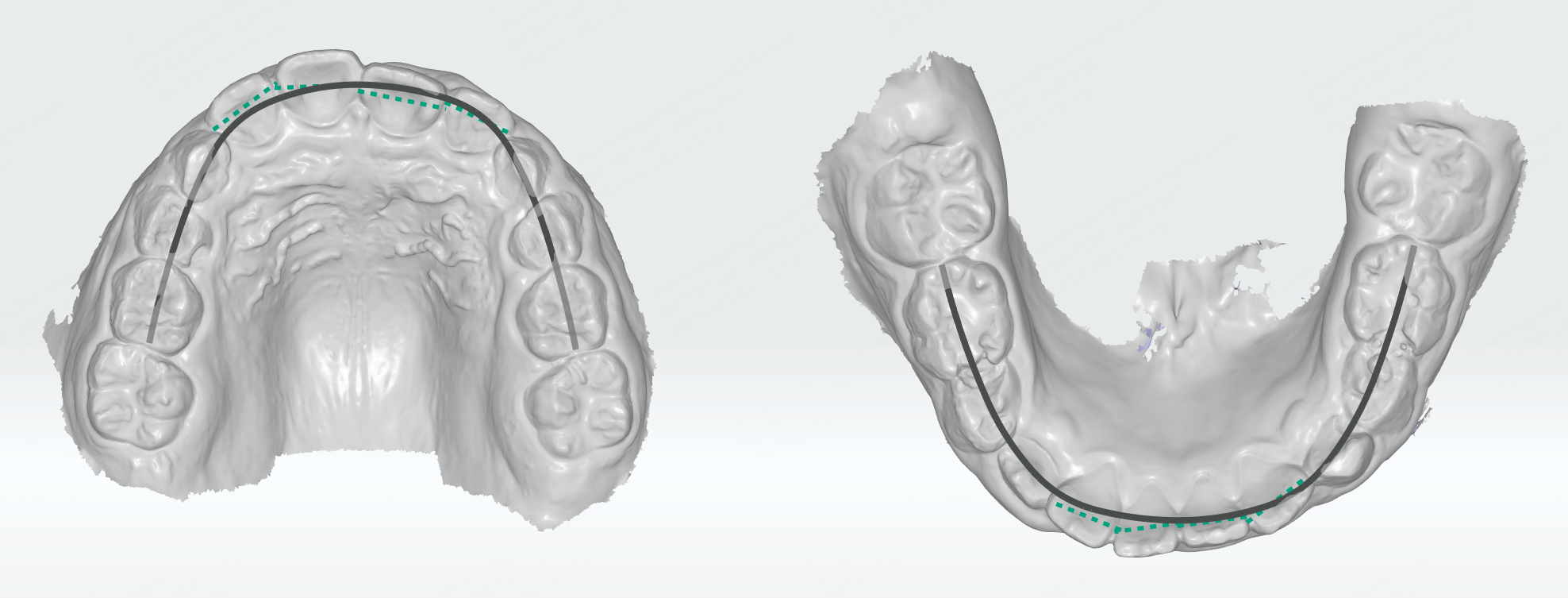
In the measurement table, move the cursor to to view the Moyers measurement method. Click Check the Moyers table to pop up the Moyers analysis table of tooth width for males and females.
You can move, zoom, and perform other operations on the measurement table. For details, please refer to Measurement Table Operations.
Measurement Method:
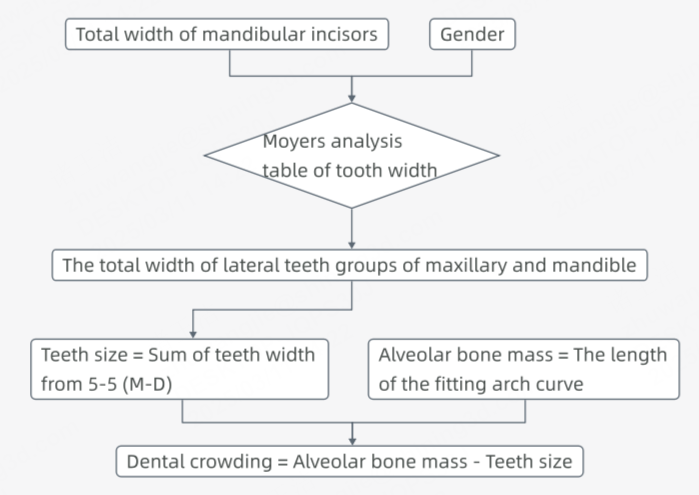
-
Click the dental arch (which will be colored in blue), and a panel for dental arch shape adjustment will appear at the bottom right corner.
-
On the panel, you can hold the control point on the dental arch curve and move the cursor to adjust the shape of the dental arch.
-
After clicking a tooth on the green dashed line, the label will display the tooth width and a panel for width adjustment will appear at the bottom right corner.
-
On the panel, you can rotate the tooth to align the mesiodistal and buccolingual directions with the coordinate axes. The measurement value of the tooth width will be updated in real-time.
Note
To move the panel, you can hold at the top right corner of the panel and move the cursor.
Spee Curve
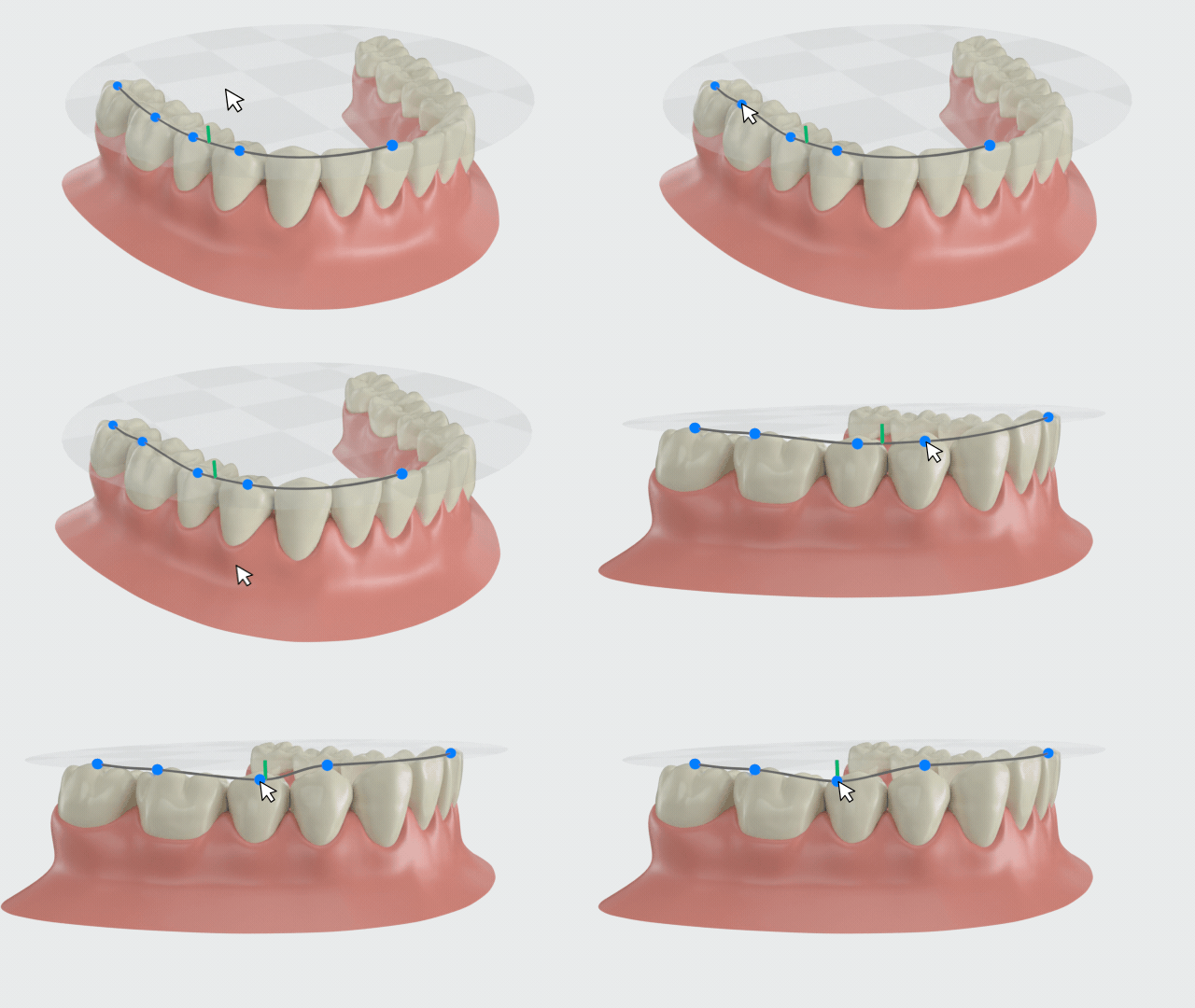
The leveling of the Spee curve is a key factor for the success of orthodontic treatment. Click  to enter this function. The fitted Spee curve and plane of the lower jaw will be automatically generated. A measurement table will be generated as well.
Note
If there are too many teeth missing (e.g., missing lower central incisors or both the first and second molars on the same side) on the imported model, the measurement of the Spee curve is not available.

- The plane is formed by three points: the midpoint of the incisal edge on the central incisors of the lower jaw, the distobuccal cusp tips of the second molars on both sides of the lower jaw (or the distobuccal cusp tips of the first molars on both sides).
- The curve is formed by multiple feature points on the teeth.
- The green line represents the distance from the lowest point of the Spee curve to the plane.
You can move, zoom, and perform other operations on the measurement table. For details, please refer to Measurement Table Operations.
Measurement Method:
Create fitted curve of Spee and plane, and calculate the distance from the lowest point of the curve to the plane.
Manual Adjustment
You can manually adjust the Spee curve by moving the blue feature points on the curve. The measurement results in the table will be updated in real-time.
Occlusion
Click  to enter occlusion measurement, which is divided into four measurement tools: Overbite and overjet, Molar relationship, Canine relationship, and Midline relationship.
Caution
When importing a single jaw, occlusion measurement is not supported.
Overbite and overjet
Overbite and overjet measurement helps you view the occlusal relationship between the upper and lower teeth of the patient, aiding in diagnosing occlusal problems.
Click  to enter overbite and overjet measurement. Teeth with overbite and overjet relationships will be automatically detected. Feature lines at 1/3, 1/2, and 2/3 of the crown and feature points will be generated.
A measurement table will also be generated, including tooth position, overbite degree, and overjet degree.
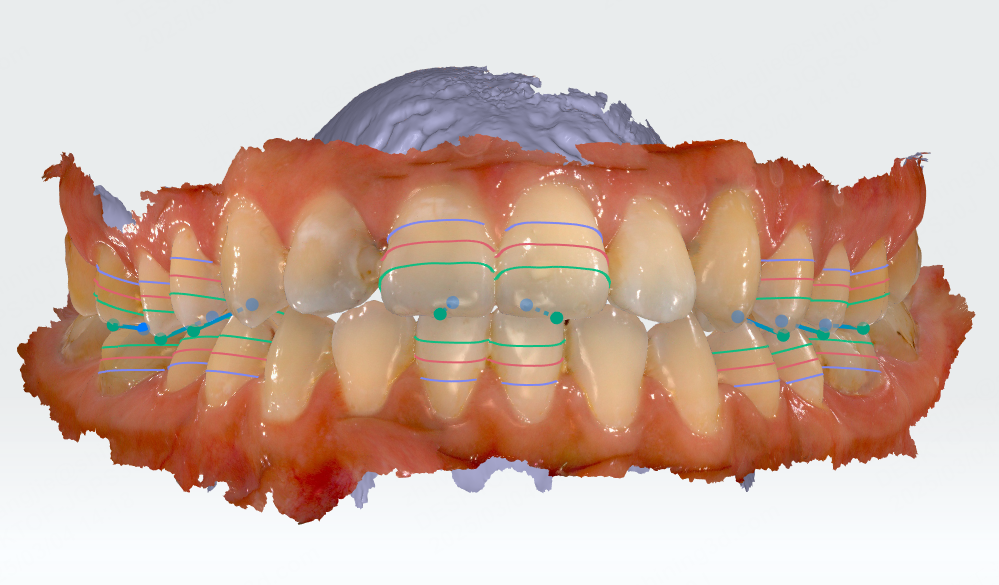
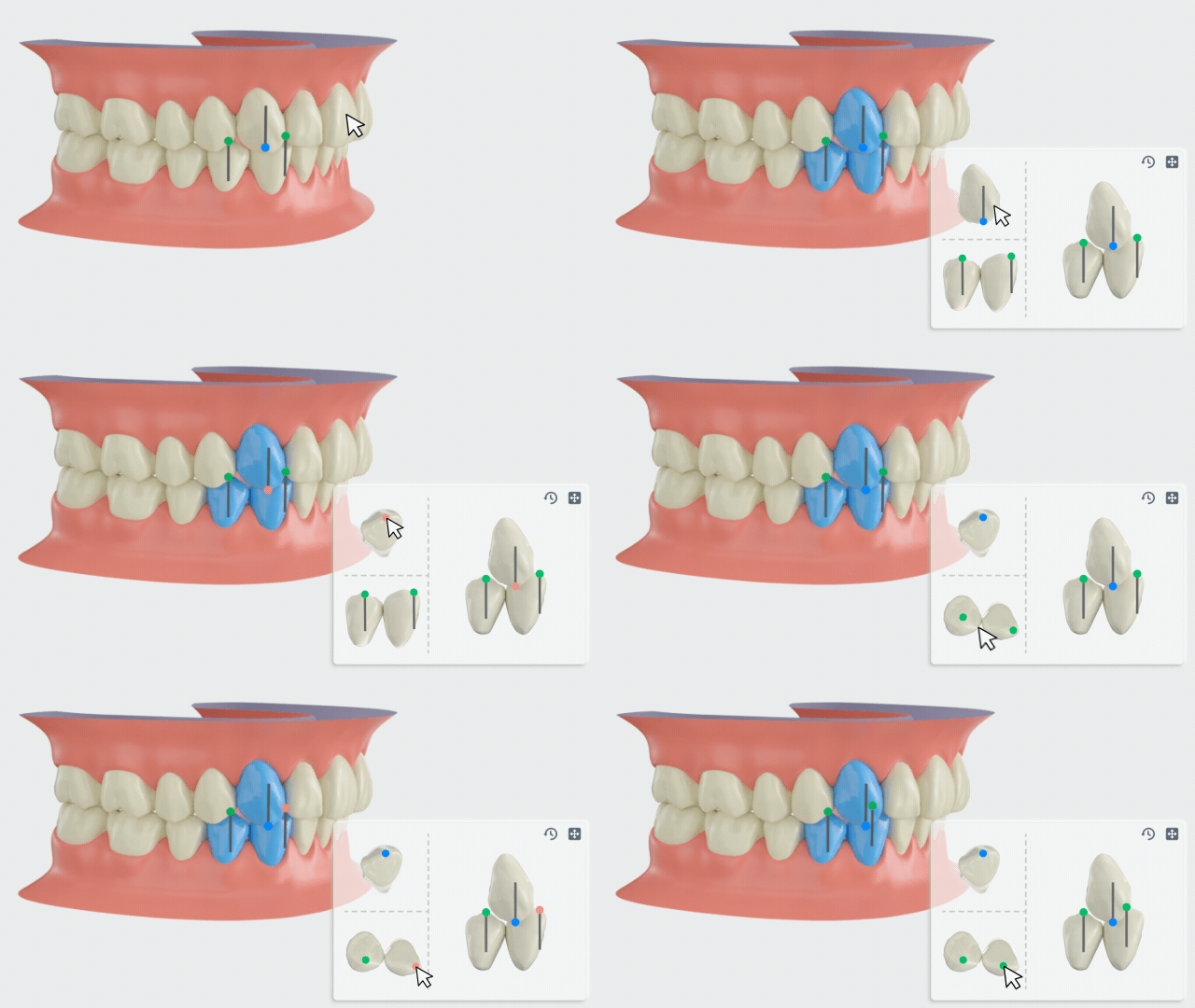
Manual adjustment of feature points
-
Click a pair of teeth to be adjusted, and the adjustment panel will be displayed at the bottom right corner.
-
On the left side of the panel, you can hold and move the feature point. The overbite and overjet relationships for the corresponding teeth will be updated in real-time.
You can hold the left/right mouse button to rotate the teeth.
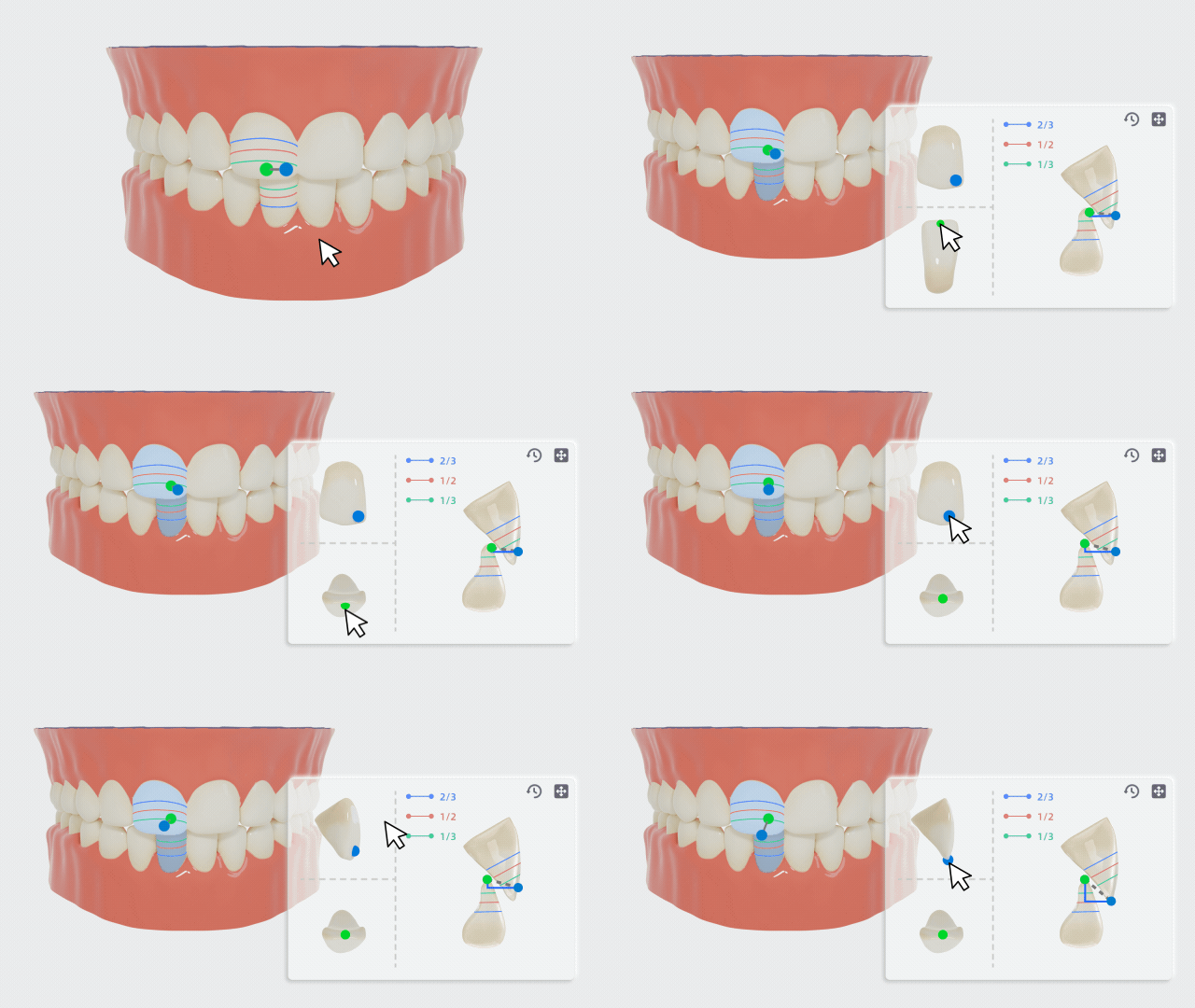
-
Take the upper and lower central incisors as an example. Click this pair of teeth and manually adjust the feature points on the panel.
- According to the relative position of the upper central incisor to the lower central incisor crown and the relative position of the lower central incisor to the upper central incisor crown, the overbite relationship will be displayed on the measurement table.
- Move the feature point of the upper incisal edge to adjust the length of the line connecting this point to the point of the lower incisal edge. The overjet relationship measurement will be displayed on the measurement table.
Relationship of Molar
Click  to enter the molar relationship measurement. Different feature points will be displayed according to different stages (primary dentition, mixed dentition and permanent dentition).
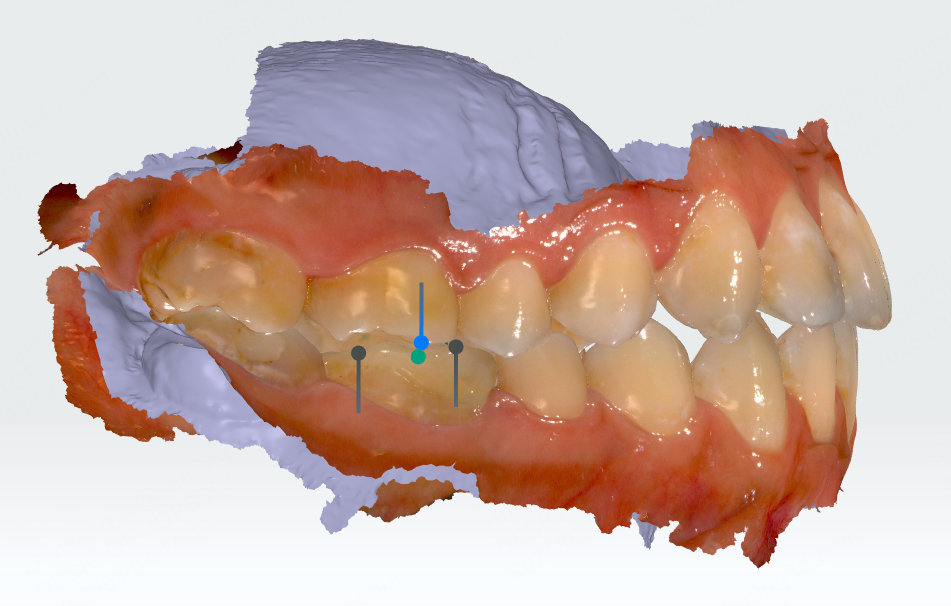
| Period | Feature Points |
|---|---|
| Primary dentition | Mesial buccal cusp tips of the second primary molars (55 and 65) and mesial buccal groove points, mesial buccal cusp tips, and distal buccal cusp tips of the second primary molars (75 and 85). |
| Mixed dentition | Mesial buccal cusp tips of the first molars (16 and 26) and mesial buccal groove points, mesial buccal cusp tips, and distal buccal cusp tips of the first molars (36 and 46). |
| Permanent dentition | Mesial buccal cusp tips of the first molars (16 and 26) and mesial buccal groove points, mesial buccal cusp tips, and distal buccal cusp tips of the first molars (36 and 46). |
Molar relationship
| Position | Molar Relationship |
|---|---|
| Mesial buccal cusp tip of the maxilla is between the mesial and distal buccal cusp tips of the mandible | Neutral relationship |
| Mesial buccal cusp tip of the maxilla is anterior to the mesial buccal cusp tip of the mandible | Distal relationship |
| Mesial buccal cusp tip of the maxilla is posterior to the distal buccal cusp tip of the mandible | Mesial relationship |
Manual Adjustment of Feature Points
-
Click a pair of teeth with a molar relationship, and the adjustment panel will be displayed at the bottom right corner.
-
On the left side of the panel, hold and move the feature points of the teeth to modify the molar relationship.
You can hold the left/right mouse button to rotate the upper and lower teeth.

-
Take teeth at the permanent dentition stage as an example. Move the feature point on the panel to adjust the distance between this point and the buccal groove point, mesial buccal cusp tip, and distal buccal cusp tip of the mandible, thereby determining the molar relationship on both sides of the teeth.
Note
If one or both teeth in a pair of molar relationship are missing, the feature points for that pair of teeth will not be displayed.
Tooth Tip Relation
A neutral canine relationship is a prerequisite for normal occlusion and function.
Click  to enter the canine relationship measurement. It will automatically identify the cusp tips of the canines (13, 23, 33, 43) and the buccal cusp tips of the first premolars (34, 44), and generate feature points. A canine relationship measurement table will also be generated.
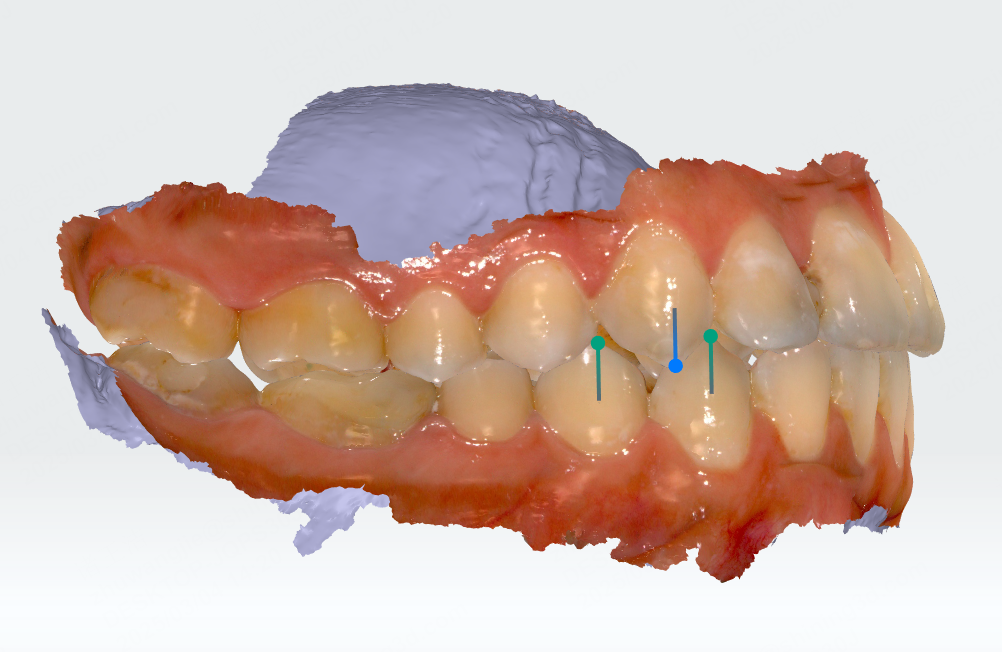
Canine relationship
| Position | Canine Relationship |
|---|---|
| The line connecting the cusp tips of the maxillary canines is between the cusp tips of the mandibular canines and the buccal cusp tips of the mandibular first premolars | Neutral relationship |
| The line connecting the cusp tips of the maxillary canines is anterior to the cusp tips of the mandibular canines | Mesial relationship |
| The line connecting the cusp tips of the maxillary canines is posterior to the buccal cusp tips of the mandibular first premolars | Distal relationship |
Manual adjustment
- Click teeth with a canine relationship, and the adjustment panel will be displayed at the bottom right corner.
-
On the left side of the panel, hold and move the feature point to modify the canine relationship.
You can hold the left/right mouse button to rotate the upper and lower teeth.
Midline Relationship
Midline relationship measurement can be used to evaluate whether the midlines of the upper and lower teeth are aligned during orthodontic treatment.
Click  to enter the midline relationship measurement. The system will automatically detect and generate the midlines of the upper and lower teeth and generate a measurement table.

Manual adjustment
Hold and move the point in the center of the midline to move the midline. The measurement data in the table will be updated simultaneously.
Palatal Height
 Palatal Height Measurement allows you to visually examine the patient's palatal condition. By observing the patient's palatal condition and the direction of the posterior alveolar, you can determine whether the patient has dental or skeletal maxillary transverse deficiency.
If a crossbite patient has a wide and flat palate but the posterior alveolar tilts towards the palate, it may indicate a dental crossbite; if the patient has a V-shaped dental arch and/or a narrow and high palate, it may indicate a skeletal discrepancy. Measuring the palatal height can provide reference data for orthodontic treatment, helping you to develop a more precise treatment plan.
After entering this function, a line segment linking the central fossa of teeth 16 and 26 will be automatically generated. The distance between the palate and the midpoint of this line segment is the palatal height.
Caution
- Palatal height measurement is only supported for the upper jaw when importing a single jaw.
- Please ensure the model is completely scanned, otherwise, palatal height measurement is not supported.

By moving the blue control points at both ends of the line segment, you can measure the palatal height at other positions. The measurement results in the table will be updated in real-time.
You can move, zoom, and perform other operations on the measurement table. For details, please refer to Measurement Table Operations.
Measurement table operations
| Operation | Description | Operation | Description |
|---|---|---|---|
| Move table | Hold  and drag the cursor. and drag the cursor. |
Show tooth width list | Click Tooth Width List to switch the measurement table. |
| Hide table | Click  to hide the table. to hide the table. |
Show table | Click  at the bottom left corner of the interface to show the table. at the bottom left corner of the interface to show the table. |
| Show/Hide reference values | Click  / / to show/hide reference values. to show/hide reference values. |
Modify measurement results | Double-click the values on the table or select the values on the dropdown list. The modified values will be displayed in blue. Click  to restore the initial values. to restore the initial values. |
Model Comparison
Model Comparison is a tool that can compare and analyze the differences in a patient's intraoral data at different times. It can monitor multiple sets of tooth position changes and intraoral tooth wear data for orthodontic treatment.
Click Model Comparison and select two sets of data to enter the model comparison interface.
Note
Supports split-screen and overlay display. When in overlay mode, you can move the comparison axis to see the differences between the two sets of data.
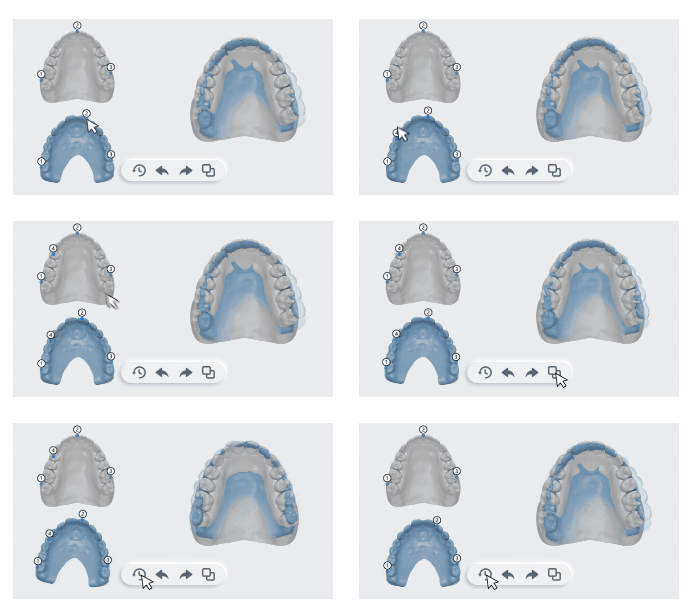
Model alignment
The models from different treatment periods are aligned according to the feature points, both automatically and manually.
Manual Alignment
- Click on the model to add a new point. You can press the point to move it.
-
After adding corresponding points at the same position of the two models, click
 to manually align the two models. The overlay effect of two models will be displayed.
Click
 to reset the positions if needed.