Scanning
By scanning, point cloud data can be obtained to generate accurate mesh.
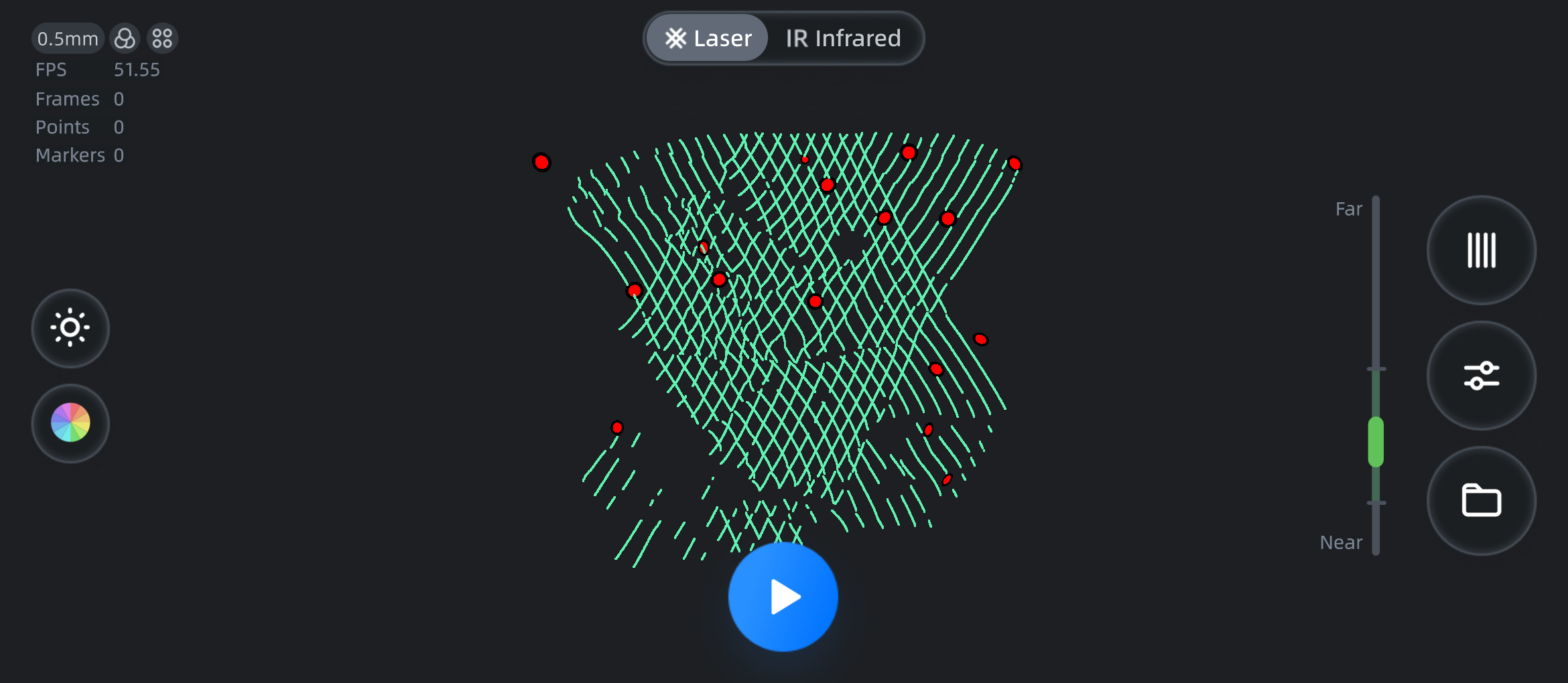
Scanning Steps
- Tap Laser or Infrared at the top of the interface to select the corresponding scan mode.
- Prepare according to the type of object to be scanned and the selected scan mode; for specific details, please refer to Preparation.
-
Set the resolution, align mode, texture, and other related scanning parameters, and adjust the scanning brightness.
- Tap
 to open advanced settings, where you can set the resolution, texture, and align mode.
 - Tap
 to open the camera window, and adjust the scanning brightness based on the camera view; during the scanning process, you can adjust the scanning brightness again according to the scanning effect.
 - (Optional) In laser mode, tap
 and
and  before and during scanning to switch to the corresponding light source mode.
Note
For more details, please refer to Scanning Settings.
- Tap
-
Tap the
 button at the bottom of the interface to start scanning.
 -
During the scanning process, please monitor the data on the screen in real-time, and move the scanner slowly and steadily until the object to be scanned is completely scanned.
Note
- If prompted "Tracking Lost" during scanning, please adjust the posture in a timely manner, move the scanner to the already scanned area, and continue scanning after re-tracking.
- In Global Markers mode, you need to scan the global markers first before scanning the point cloud.
-
Tap the
 button at the bottom of the interface to pause scanning.
 -
Check the integrity of the data through operations such as rotation and zooming.
Function Description Pan Slide to pan the model with two fingers. Rotate Slide to rotate the model with one finger. Zoom Pinch or spread with two fingers to zoom the model. 
Tap this button to restore the model to its original size and reset it to the center of the screen. -
If the data is incomplete or of low quality, tap the
button at the bottom of the interface to continue scanning; if you need to rewind the frame, tap the  button to access the rewind function; if you are not satisfied with the overall data, tap the
  button to clear the scanned data and start scanning again.
Note
- The rewind function is only available in IR Scan.
- During scanning or when the scan is paused, you can modify the resolution of the current project; after modifying the resolution, the
 Data Quality Indicator will be enabled automatically, allowing you to scan again in areas with lower quality (yellow areas) based on the quality indicator until those areas turn blue.
-
After completing the scan, tap the
 button at the bottom of the interface to enter the Point Cloud Editing interface, where you can edit and clip the scanned data to remove redundant data.
 - (Optional) If you cannot complete all scans in one project, tap Complete in the point cloud editing interface to return to the scan interface, at which point a new project will be automatically created under the current project group, allowing you to repeat the above steps to scan again. If you complete all scans in one project, tap Complete in the point cloud editing interface to return to the scan interface, at which point you can click
 to create a new project group for scanning.
Note
When creating a project, projects within the same project group do not support switching align modes.
Global Markers Files
When selecting Global Markers mode, you can quickly export or import global markers files.
Export
In Marker Alignment mode or Global Markers mode, when the number of scanned markers > 4, tap  to save the global markers file to the scanner for later import.
Note
- Custom naming of exported global markers files is supported.
- In Global Markers mode, when scanning the point cloud, if Add global markers is enabled, all recognized markers will be exported.
- In Laser mode, after scanning the point cloud, tap
 to optimize the scan, and then tap to export the global markers file.
Import
When scanning global markers again, you can go to the scan interface > Advanced Settings > Global Markers, tap Import global markers, and select the corresponding global markers file to import.
Note
If the imported global markers file contains unrecognized marker's sizes, the import will fail; for details on the supported marker sizes for each align mode, please refer to the advanced settings content in Scanning Settings.