Welcome
This user manual (hereinafter referred to as "the Manual") introduces the device appearance and operation procedure of EinScan Trak.
Symbol Conventions
The Declaration of Intellectual Property and Disclaimer
EU Statement
This device is restricted to indoor use when operating in the 5150-5250 MHz frequency range.
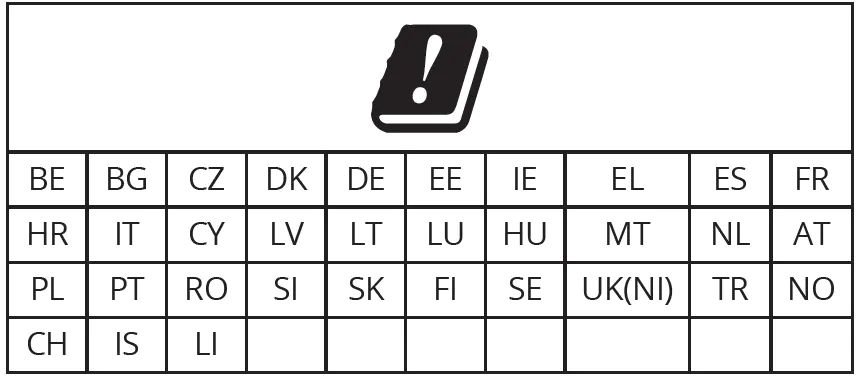
Frequency Range (RF)
Wi-Fi (5G):
Band 1: 5150-5250 MHz (TX/RX), 5.1 GHz Wi-Fi: < 23 dBm (.e.i.r.p)
Band 4: 5725-5850 MHz (TX/RX), 5.8 GHz Wi-Fi: < 14 dBm (.e.i.r.p)
RF Exposure EU
The Scanner:
This device is designed not to exceed the limits of emission of radio waves recommended by international guidelines. These guidelines include safety margins designed to assure the protection of all persons, regardless of age and health.
SAR (specific absorption rate) is the unit of body-absorbed RF quantity when the pad is in use. SAR value is ascertained according to the highest RF level generated during laboratory tests.
The SAR limit is 2.0 W/kg body SAR and 4.0 W/kg limb SAR averaged over ten grams of tissue for EU.
Body-Worn: The use of belt clips, holsters and similar accessories should not contain metallic components in its assembly. The use of accessories that do not satisfy these requirements may not comply with RF exposure requirements and should be avoided.
To maintain compliance with RF exposure requirements, a 5mm separation distance between the user's body and the back of the device should be maintained.
The Tracker:
RF Radiation Exposure Statement Caution: This Transmitter must be installed to provide a separation distance of at least 20 cm from all persons.
FCC Statement
This equipment has been tested and found to comply with the limits for a Class B digital device, pursuant topart15 of the FCC Rules. These limits are designed to provide reasonable protection against harmful interference in a residential installation. This equipment generates, uses and can radiate radio frequency energy and, if not installed and used in accordance with the instructions, may cause harmful interference to radio communications. However, there is no guarantee that interference will not occur in a particular installation. If this equipment does cause harmful interference to radio or television reception, which can be determined by turning the equipment off and on, the user is encouraged to try to correct the interference by one or more of the following measures:
Reorient or relocate the receiving antenna.
Increase the separation between the equipment and receiver.
Connect the equipment into an outlet on a circuit different from that to which the receiver is connected.
Consult the dealer or an experienced radio/TV technician for help.
Changes or modifications not expressly approved by the manufacturer could void the user’s authority to operate the equipment.
Industry Canada Statement
This Class B digital apparatus complies with Canadian ICES-003.CAN ICES-3(B)/NMB-3(B).
This device complies with Industry Canada license-exempt RSS standard(s).
Operation is subject to the following two conditions: (1) This device may not cause interference, and (2) This device must accept any interference, including interference that may cause undesired operation of the device.
Le present appareil est conforme aux CNR d'Industrie Canada applicables aux appareils radio exemptsdelicence. L'exploitation est autorisee aux deux conditions suivantes : (1) L'appareil ne doit pas produiredebrouillage, et (2) L'utilisateur de l'appareil doit accepter tout brouillage radioelectrique subi, meme si lebrouillageest susceptible d'en comprome re le fonctionnement.
RESTRICTIONS IN THE 5 GHZ BAND
Within the 5.15 to 5.25 GHz band, UNII devices will be restricted to indoor operations to reduce any potentialforharmful interference to co-channel Mobile Satellite System (MSS) operations.
RESTRICTIONS DANS LA BANDE DE 5 GHZ
Dans la bande de 5,15 à 5,25 GHz, les appareils UNII seront restreints aux opérations intérieures pourréduiretoute possibilité d'interférence pouvant nuire aux opérations du Système satellite mobile dans lemêmecanal (MSS).
RF Exposure FCC/ISED
The Scanner:
The SAR limit of USA/Canada is 1.6 W/kg averaged over one gram of tissue for Body and 4.0 W/kg averaged over ten grams of tissue for extremity SAR, this device has also been tested against the SAR limits.
Body-Worn: The use of belt clips, holsters and similar accessories should not contain metallic components in its assembly. The use of accessories that do not satisfy these requirements may not comply with RF exposure requirements and should be avoided.
To maintain compliance with RF exposure requirements, a 10mm separation distance between the user's body and the back of the device should be maintained.
La limite du das des États-Unis et du Canada est de 1,6 W/kg en moyenne sur un gramme de tissu pour le corps et de 4,0 W/kg en moyenne sur dix grammes de tissu pour le das des extrémités.
Porté sur le corps: l'utilisation de clips de ceinture, de étuis et d'accessoires similaires ne doit pas contenir de composants métalliques dans son assemblage.L'utilisation d'accessoires qui ne satisfont pas à ces exigences peut ne pas être conforme aux exigences d'exposition aux RF et devrait être évitée.Pour maintenir la conformité aux exigences d'exposition aux RF, une distance de séparation de 10mm entre le corps de l'utilisateur et l'arrière de l'appareil devrait être maintenue
The Tracker: RF Radiation Exposure Statement Caution: This Transmitter must be installed to provide a separation distanceofat least 20 cm from all persons.
Déclaration d'exposition Attention: Cet émetteur doit être installé pour fournir une distance de séparationd'aumoins 20 cm de toute personne.